Today, we at AntiquityNOW commemorate that most wondrous of all human emotions: Love. On past Valentine’s Days, we have explored how love enters through the eyes and nose, how the brain on love is a power to behold (Robert Palmer does a cameo in this one) and even offered up an ancient Thai rose salad recipe to enjoy on this holiday. But being the curious afficionados of ancient history we are, we wondered, where did the heart-shaped symbol originate?
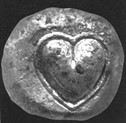
Ancient silver coin from Cyrene
depicting a seed or fruit of silphium.
As where many ancient secrets begin, let’s look at nature. There are numerous plants with blossoms or leaves in the shape of the symbol we now see as a heart. But the one in history that is most relevant, had multitudinous uses in ancient times and is an eternal mystery to the science of propagation is silphium. Also known as silphion, laserwort, or laser, it was widely used by Egyptians, Knossos Minoans, Greeks and Romans as a seasoning, medicine and perfume. And in a cheeky irony by Mother Nature, it was also popular as an aphrodisiac and a reportedly effective contraceptive. It grew naturally around the North African city of Cyrene (founded as Greek city in 631 BCE at what is now Shahhat, Libya), and was such an important trade item that Cyrenian coins displayed its heart-shaped seed or fruit. It was documented as literally worth its weight in gold.[1] From this description, it certainly appears to be a cure-all:
It was said to have short, thick leaves, tiny yellow flowers, and bulky, vigorous roots. The sap that oozed from the silphium plant was particularly aromatic and medicinal, at least by ancient standards. The wonder drug of its day, silphium was said to cure such maladies as tooth decay, warts, dog bites, stomach ailments, coughs, leprosy, and anal growths. But it was more valued for its use as a contraceptive…more specifically as an abortifacient. Ancient medical texts all repeat the claim that a pessary made of silphium sap was effective at “purging the uterus” to “bring forth menstruation”, all clever euphemisms for drug-induced abortions. In a society that placed a high value on legitimate heirs …, silphium’s (sic) became highly sought after as the first “morning-after” pill.[2]
Continue reading →

 Southern cuisine has deep roots in Africa. One of the most vibrant cultures contributing to the South’s identity was actually one that evolved from unintended diversity.






 AntiquityNOW