
 Have you ever planted a seed and watched it grow into a plant? It’s an incredible feeling to see a tiny little seed turn into a fruit or a vegetable. Did you know that some of the seeds we use to grow our food today come from seeds harvested by cultures that existed thousands of years ago? These ancient seeds are called heirloom seeds and they’ve been passed down from generation to generation. They produce some of the most delicious fresh fruits and vegetables of all varieties. Continue reading
Category Archives: Kids Blog
KIDS’ BLOG! Heirloom Seeds From Our Great-Great-Great-Great-Great (and many more!) Grandparents
KIDS’ BLOG! The Invention of the Wheel: How the Ancient Sumerians Got Humanity Rollin’!
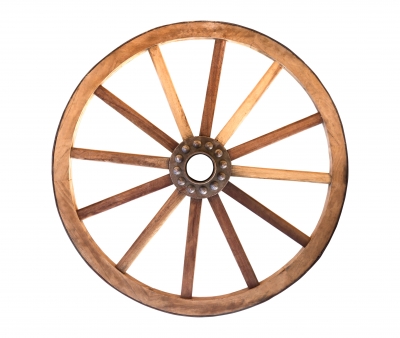
“Wooden Cartwheel” Image courtesy of Stoonn/ FreeDigitalPhotos.net
When we think about the invention of the wheel, the picture that jumps into our minds is the wheel from a car or maybe an ancient Roman chariot. The earliest wheels, however, were much different than 21st century wheels or even those used in first century battles.
The wheel was invented by the ancient Sumerians. They lived in the land between the Tigris and the Euphrates Rivers in the Middle East. Much, much later this land became part of the country we call Iraq. The Sumerians were the first people to develop a written language. Extensive studies of their writings have led archaeologists and historians to also credit them with the invention of the wheel. Continue reading
Posted in Blog, Engineering, Kids Blog, Kids: Engineering, Kids: Science and Tech, Science and Technology
Tagged ancient history, AntiquityNOW, Mesopotamia, Sumeria, wheel
KIDS’ BLOG! Hot Fudge Sundae: A Dessert 5,000 Years in the Making
 So how much do you like ice cream? Ice cream with hot fudge…ice cream with sprinkles…ice cream with gumdrops…there really are many varieties and toppings. Let’s see how these ice cream treats were invented, beginning 5,000 years ago in China! Continue reading
Posted in Culinary, Culture, Kids Blog, Kids: Culinary, Kids: Culture
Tagged ancient history, AntiquityNOW, candy China, gumdrops, hot fudge, ice cream, sprinkles, whipped cream
KIDS’ BLOG! Ancient People Loved Chewing Gum!
 What is your favorite flavor of chewing gum? Whether it is spearmint, wintergreen, cinnamon or fruit flavored, chewing gum is one of the world’s most popular habits with nearly 100,000 tons consumed per year. Gum seems like a very modern invention with its fun flavors, colors and special additives for energy, fresh breath, teeth whitening and more. In fact, the oldest known piece of chewing gum dates back at least 5,000 years and was found by an archaeology student in Finland.[1] It was a simple lump of birch bark tar that experts believe was chewed by Neolithic people to heal mouth infections. Continue reading
Posted in Blog, Culinary, Culture, Kids Blog, Kids: Culinary, Kids: Culture, Kids: Public Life, Kids: Recreation, Public Life, Recreation
Tagged Ancient Greece, ancient history, AntiquityNOW, Aztecs, chewing gum, chicle, Finland, mastic, mastiche, Mayas, Wrigley
KIDS’ BLOG! Boom! Pow! Whizzz!: The History of Fireworks

Displays of fireworks are widely used on festive occasions, as at the opening ceremony of Beijing Olympic Games, 2008.
Fireworks are used by many cultures to celebrate holidays and important events. Their spectacle unites people and commemorates cultural milestones. Kaleidoscopic bursts against the night sky, spirals of colored fire, glimmering waterfalls—all the effects that give pounding delight to children and adults alike. Continue reading
Posted in Annotated, Art, Blog, Culture, Holidays, Kids Blog, Kids: Art, Kids: Culture, Kids: Holidays, Kids: Public Life, Kids: Recreation, Kids: Science and Tech, Public Life, Recreation, Science and Technology
Tagged ancient history, AntiquityNOW, celebrations, china, fireworks, Fourth of July, Independence Day, Italy
KIDS’ BLOG! Ancient Toys, Wii and You

Update! This post was originally published on June 6th, 2013. In many places around the world, school’s out for summer break. For the next few weeks, kids will be turning to toys for entertainment. And when it comes to toys with all the bells and whistles (and high-end graphics, music, etc.), our modern world definitely doesn’t disappoint. In the post below, we take a look back at how ancient kids entertained themselves with toys that aren’t so different from the ones we have today. But first, click here to see a slideshow of some ancient toys from the imperial court of the Qing Dynasty (1644-1911) in China. These fascinating and even mysterious toys were used by the princes and princesses of the kingdom. Some you might recognize, others you might not. Try to imagine how you would play with these toys today. And don’t miss the brand new activity below!
*********************************************
We might assume that ancient civilizations spent all their time working very hard—hunting or growing their food, fighting their enemies and just trying to survive. Instead, archaeologists and historians have discovered that many of these people enjoyed playing as well as working together.
The early Mesopotamians, who lived between the Tigris and Euphrates rivers in what is now modern day Iraq, knew how to enjoy life! They played sports, developed fun games for both adults and children, and found creative ways to entertain themselves. They even set up their calendar to include six holidays each month, celebrating them with rituals and festivals. Each new month started when they saw the first sliver of the moon in the sky. They had three lunar festivals (based on the phases of the moon) and an extra three days just for relaxing. Some of their celebrations were annual, like the equinox (when the length of the days and nights were equal) and the solstice (when the sun is the farthest from the equator). Others were religious or anniversaries of military victories, and other special Mesopotamian events.
During these celebrations the king would often participate in a ritual hunt. This type of hunt was more of a show. He didn’t do much actual hunting. The king was well-protected by his soldiers, and in the end he would always successfully kill the animals to prove that he had favor with the gods, had control over the animals, and was a legitimate king.[1]
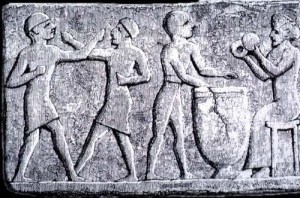
Terracotta relief depicting two men boxing to musical
accompaniment, c. 1200 B.C.E., Sinkara (modern-day Tell as Senkereh, Iraq).
Source: Flickr at http://www.flickr.com/photos/pankration (Pankration Research
Institute’s photostream).
The common people also participated in a variety of sports and games during holidays. Stone carvings, metal art and terra-cotta (red clay) plaques show that boxing and wrestling were especially popular in Mesopotamia. Two men would dramatically beat on an enormous drum during boxing matches, probably to add excitement to the event.[2] The Mesopotamians also played polo, except that instead of riding on horses, the players sat on the shoulders of other men.[3] Interestingly, there is evidence that the Mesoamericans—located an ocean away in Central America–were playing polo this same way.
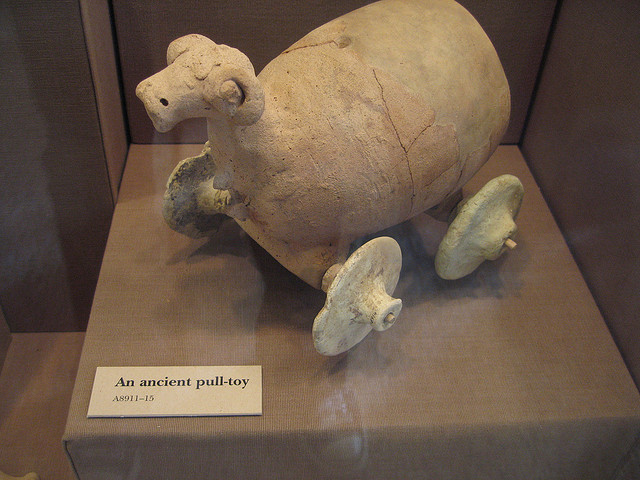
An ancient pull-toy at the Oriental Institute Museum.
The children of Mesopotamia were encouraged to play with miniature toys not only for fun, but also to help master adult skills. They played house with dolls and tiny animals and furniture. They had toy chariots, wagons and ships. They were given safe weapons so that they could imitate the adults in hunting and battle. These included bows, arrows, sling shots, long sticks for throwing and even boomerangs. They also had action games and toys like spinning tops, rattles, jump ropes, balls and a game almost like hockey, except that players used mallets and a puck.[4]
Many of today’s toys are similar, but now both children and adults can enjoy very realistic play anytime. We don’t have to wait for a holiday or festival like the Mesopotamians did to play sports or relax. With the invention of video gaming systems like Wii, we can play after school or in the evening with our families. Systems like Wii let us go through all the motions of hunting or boxing without the risk of being hurt. The technology allows us to control the actions of our character on the TV screen by moving our hands and feet with remote gadgets. We can gain skills at sports and martial arts without ever leaving our homes. This is as close to the real thing as pretending could ever be.
Throughout history, people have played games, not only for recreation, but also to learn activities important for life in their society. Today, Wii turns play into an active imitation of life for children and adults alike. Just as the Mesopotamians did in their day with their leisure activities, we in the 21st century also take our fun seriously.
Activities
Mesopotamia Art Project: Compare a Mesopotamian father in battle and his children playing war with their toys.
- Click here for pictures of Ancient Mesopotamian weapons.
- Measure and mark a point halfway down a piece of art paper and draw a horizontal line across to the other side. You are going to make two pictures about a Mesopotamian family. Go to the above link for pictures of ancient Mesopotamian weapons. Use the pictures to help you draw accurate pictures of the weapons.
- In the top space, draw a Mesopotamian warrior in battle using his weapon (sword or spear). In the bottom space, draw his two children at home playing with their toy weapons (wooden swords, throwing sticks or other toy weapons mentioned in the blog). You can add other miniature toys from the story like toy chariots, wagons and ships to the picture.
- Label your picture with the words, “A Mesopotamian Father at War” and “Mesopotamian Children Playing Warrior.”
Qing Dynasty Building Blocks: Just like todays’ teachers, educators in the Qing Dynasty knew that building blocks were great toys to help expand growing minds, foster intelligence and have creative fun. You can make your very own building blocks with tools around the house, but make sure you ask your parents to help!
- Collect empty boxes. You’ll probably find most of the boxes in the kitchen. Cereal and food boxes are perfect.
- Wrap the boxes in plain wrapping paper or construction paper. Reinforce the corners with clear tape. You might want to let your parents do this step.
- Use colored markers, pens and pencils to decorate the boxes. You can draw windows and doors and make your own houses and buildings, or draw multiple houses and buildings on each box and create neighborhoods. Leave the boxes plain and use them to build anything you can imagine! Be really creative and go 3D: cut out windows and doors, paste on pictures of greenery from magazines, draw and cut out figures of people, etc.
- Write a page as if from your own diary and describe a day living in your neighborhood. Who are you? What period of time do you live in (e.g., ancient China, modern day city)? Who are your friends? What do you like to do together? What do you see when you walk around your neighborhood?
References
1. Bancroft, Norman, Living in Ancient Mesopotamia, (Infobase Publishing, 2008), 176.
2. Murray, Steven Ross, “Boxing Gloves of the Ancient World”, Journal of Combative Sport, July 2010, http://ejmas.com/jcs/2010jcs/jcsart_murray_1007.html
3. Nejat, Karen Rhea Nemet, Daily life in ancient Mesopotamia (Greenwood Publishing Group, 1998), 165.
Posted in Blog, Kids Blog, Kids: Public Life, Kids: Recreation, Kids: Science and Tech, Kids: Sports, Public Life, Recreation, Science and Technology, Sports
Tagged ancient history, AntiquityNOW, games, Mesopotamia, military, toys, war, Wii
KIDS’ BLOG! Today’s Art Inspired by the Ancient Maya and Aztec Civilizations
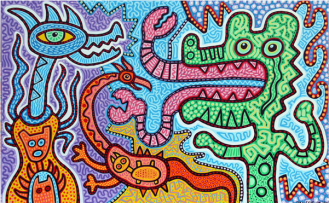
Monster Mash by Dan Fenelon
Dan Fenelon, AntiquityNOW’s Virtual Artist in Residence, looks to the past to feed his boundless imagination. He reaches in to antiquity and plucks inspiration from many ancient cultures to create a new art that is both modern and timeless. Two of the civilizations that inspire him are the Mayas and the Aztecs. Both flourished for thousands of years and created some of the most beautiful and recognizable works of art and architecture. Continue reading
Posted in Art, Blog, Culture, Kids Blog, Kids: Art, Kids: Culture
Tagged ancient art, AntiquityNOW, AntiquityNOW month, art history, Aztec, Dan Fenelon, Maya, Mesoamerican
KIDS’ BLOG! Hot Chocolate: Making Kids Happy for More Than 1,000 Years!

Image courtesy of anka @ happyhangaround
Do you love a cup of hot chocolate with lots of sweet marshmallows? Did you know that kids just like you drank hot chocolate over a thousand years ago?
The Maya people in Northern Belize were drinking hot chocolate as far back as 600 BCE. Although many people think that the Mayas discovered chocolate, the Olmec people who lived in Mexico from 1500-400 BCE were actually drinking a chocolate concoction even earlier. Do you enjoy your food with some extra zing? In their book The History of Chocolate, Sophie and Michael Coe describe how the Olmec crushed the cacao beans, mixed them with water and spices, and then added chilies and herbs for a spicy drink. Or maybe you would have enjoyed some of the other things the Olmec added to their chocolate, such as honey for a sweeter drink and also flavorings from flowers and vanilla. Continue reading
Posted in Blog, Culinary, Culture, Kids Blog, Kids: Culinary, Kids: Culture
Tagged ancient history, AntiquityNOW, Belize, cocoa, hot chocolate, Maya




 AntiquityNOW