Category Archives: Science and Technology

Nanotechnology and the Ancient Romans: A Breakthrough 1,600 Years in the Making

Lycurgus Cup

Lycurgus Cup

The jade-green chalice with its delicately etched image of King Lycurgus entangled in grapevines is a stunning example of Roman glassmaking.  But only upon closer examination can the observer appreciate the true innovation of these Roman artists—their use of nanotechnology. Continue reading

Bon Appetit Wednesday! Ancient Bitters, Modern Cocktails

anise-660x335-1391031331When you think of the five basic tastes – salty, sweet, sour, bitter and umami, a more recent addition approximating a savory or “meaty” flavor – bitter probably isn’t your favorite. And you’re not alone if you’d prefer salty, sweet, sour or savory. The debate over whether bitter is bad has raged since prehistory. Continue reading

It’s a 3D Life: Using Minecraft to Recreate Antiquity

minecraft_wallpaper_by_woopwoopwoop11-d475steIt’s a strange world of 3D cubes that comprise environments both hauntingly beautiful and brutally harsh.  Rivers flow through peaceful meadows, deserts and jungles teem with hidden dangers and mountains loom in awe-inspiring splendor.  For the high school students in Peter Albert’s class at The Hun School, a private academy in Princeton, NJ, Minecraft is a fantasy computer game with considerably high stakes and a provocative underlying premise.  In this 3D virtual habitat, students confront a primal question:  Do you have what it takes to survive? Continue reading

Happy Valentine’s Day! The Power of Love (Pssst—It’s All in the Eyes and Nose)

393px-Red_roseRed roses are synonymous with love, and have been for centuries.  But there’s an interesting story behind the tales of starry-eyed lovers and their proclamations of everlasting romance.  The red rose it seems, has as much to do with our eyes and nose as it has to do with affairs of the heart.

First, let’s take a look at the flower that started it all:  the beauteous and aromatic rose. Roses can be traced back 35 million years according to fossil evidence.  Roses were growing wild in many places as diverse as Persia and in what is now Colorado in the United States.  As early as the 11th century BCE the Chinese were cultivating flowers of all sorts.  In fact, China has incredible biodiversity and boasts 93 species and 144 varieties of roses that are native to its habitats.[1]  China became the dominant breeder and purveyor of roses until around 300 years ago, when Europe took the lead in cultivation and breeding.[2] Continue reading

Celebrating Chinese New Year: Explore China’s Past, Present and Future With Videos From The Archaeology Channel

Chinese New Year is next Friday, January 31 and this is a perfect time to learn more about the nation’s fascinating culture and history.  An excellent way to do this is to enjoy videos from our partner, The Archaeology Channel.  In order to expedite your search, we’ve put together a list of videos that feature China, its history and contemporary issues.  Click on any title or image below to visit a page where you can view the video. Continue reading

May the Force Be With You: AntiquityNOW Marking International Star Wars Day During AntiquityNOW Month in May

Star Wars Image copyThe Star Wars series has defined generations of space enthusiasts and launched fantasy franchises that try to compete, but never beat, the original.  Not to be outdone, AntiquityNOW has a new take on this iconic brand thanks to Jason Allen, PhD., who is Coordinator of Social Science at Blue Ridge Community and Technical College.  Last year Allen created a well-received lesson plan in honor of International Star Wars Day on May 4 that featured both Star Wars and The Lord of the Rings movies.  This year Allen will be working with AntiquityNOW on another curriculum that mines the ancient motifs in these series to illustrate how science fiction can reflect life truths, whatever the life form. Continue reading

Merry Christmas! The History—and Neuroscience—of Christmas Caroling

Image courtesy of deltamike on Flickr.

Image courtesy of deltamike on Flickr.

Caroling has been a popular pastime to celebrate Christmas for hundreds of years.  Indeed, chanting and song have been a part of rituals and celebrations from some of the earliest of societies.  Whether found in the first hollowed bone flute and percussive tree stump or the widely stylized play lists of today, music has been embedded in human culture.  And as contemporary studies show, our responses to music are not just attuned to auditory preferences and social context.  Music is really a “brain thing.” Continue reading

Bon Appetit Wednesday! Happy Holidays! Enjoy an Eggnog Courtesy of Your Ancestral Genes

Image courtesy of Reese Lloyd on Flickr.

Image courtesy of Reese Lloyd on Flickr.

Eggnog is a holiday beverage with a history and a taste that can’t be beat.  To really appreciate the roots of eggnog, we have to go back 7,500 years.  That was a period critical to the human species—or at least to those of us who indulge in dairy.  It was sometime during that period that humans in the region between the central Balkans and central Europe developed “lactase persistence.” Professor Mark Thomas of University College London (UCL) Genetics, Evolution and Environment says in a 2009 study, “Most adults worldwide do not produce the enzyme lactase and so are unable to digest the milk sugar lactose. However, most Europeans continue to produce lactase throughout their life, a characteristic known as lactase persistence. In Europe, a single genetic change (13,910*T) is strongly associated with lactase persistence and appears to have given people with it a big survival advantage.” Continue reading

Chemical Warfare in the Ancient World

*This post was originally published on October 1, 2013. Don’t miss a new article about ancient warfare coming next Tuesday, November 19th. The new post will focus on terrorism throughout antiquity. 
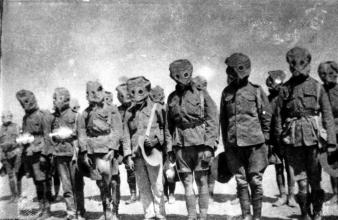
Soldiers drill in their gas masks during WWI.

Soldiers drill in their gas masks during WWI.

Chemical warfare has been a hot topic recently due to the ongoing crisis in Syria. This is just the latest of numerous modern-day examples when nations have implemented chemical weapons to further their own agendas. The most memorable examples are World War I, World War II and the Iran-Iraq War. Unfortunately, the use of chemical weapons dates back a lot earlier than the beginning of the 20th century–namely 10,000 BCE. Continue reading

KIDS’ BLOG! How “Thinking Outside the Box” Has Helped Archaeologists

Girl with Light BulbSuppose that you have a problem to solve, but nothing you’ve tried so far has worked. What would you do?  You could try “thinking outside the box.”

“Thinking outside the box” is a creative way to imagine other possibilities. It involves coming at the problem from a different perspective—one that hasn’t been tried yet.  The “box” is a fun way of picturing the ordinary ways of solving a problem.  It contains all the things that have been tried before.  When you think outside the “box,” you stretch your imagination and explore how else the problem could be solved.  Scientists, philosophers and inventers have all discovered that this method is one of the best ways to figure out the answer to a stubborn problem. Continue reading