

 Girl Be Heard’s Co-Founder and Executive Director Jessica Greer Morris is a recipient of SELF Magazine’s 2013 Women Doing Good Award, which will also recognize Shakira, Padma Lakshmi and Scandal‘s Katie Lowes at an event in New York City hosted by Today’s Hoda Kotb. Read the full press release here. Continue reading
News From Girl Be Heard, AntiquityNOW Partner for AntiquityNOW Month 2014
Posted in Blog, Culture, Human Rights, Public Life
Tagged AntiquityNOW, AntiquityNOW month, Girl Be Heard, Jessica Morris, SELF magazine, Women Doing Good
Traditional Meets Modern: Celebrating the Food of Rosh Hashanah

The Shofar is blown in a synagogue during Rosh Hashana. Image courtesy of How Stuff Works.
L’Shanah Tovah![1] It is the first full day of Rosh Hashanah, the Jewish New Year, and Jews around the world are celebrating with introspection, prayers for renewal and food having meaning and symbolism for the holiday. Continue reading
Posted in Blog, Culinary, Culture, Holidays, Public Life, Religion
Tagged ancient history, AntiquityNOW, honey, Jewish New Year, Judaism, pomegranate, Rosh Hashanah
What’s That Baby T-Rex Doing in My Birdcage?

Guanlong wucaii
UPDATE! Originally published on December 12, 2012, this was AntiquityNOW’s first blog post! The dinosaur/avian connection is back in the news today with the announcement that Australia will be the first country to publicly display specimens of Guanlong wucaii, a relative of Tyrannosaurus rex that helped confirm the link between dinosaurs and birds. The Guanlong wucaii is the T-Rex’s oldest relative living around 90 million years before its gigantic relative. Unlike the more famous T-Rex, the Guanlong wucaii much more closely resembled our modern day birds as its body was covered in feather-like structures. Stephen Wroe, associate professor at University of New England and a palaeontologist, said, “It might be hard to imagine how Tyrannosaurus, with its huge size and famously tiny arms, could be related to birds. But Guanlong demonstrates earlier relatives of Tyrannosaurus were much more avian – more lightly built and with longer forelimbs.”[1] Continue reading
Posted in Biology, Blog, Science and Technology
Tagged ancient history, AntiquityNOW, birds, dinosaurs, history, paleontology
Ancient Volcanic Eruptions Lead to Modern Predictions

Computer generated imagery of the eruption of Mount Vesuvius as seen from Pompeii in 79 AD.
This past Saturday, August 24th, marked the generally accepted anniversary of the 79 CE eruption of Mount Vesuvius in Italy. It has been centuries since the famous volcano erupted and destroyed the cities of Pompeii and Herculaneum, burying them under a pyroclastic flow and preserving them in stunning and tragic detail. An estimated 16,000 people lost their lives in the days that followed. Today, 2,000 years later, scientists are using data gained from such ancient eruptions to ensure that fewer lives are lost when volcanoes erupt. Continue reading
Posted in Blog, Meteorology, Natural Disasters, Public Life, Science and Technology
Tagged ancient history, AntiquityNOW, Mount Vesuvius, Pompeii, volcanoes, weather
KIDS’ BLOG! Heirloom Seeds From Our Great-Great-Great-Great-Great (and many more!) Grandparents
 Have you ever planted a seed and watched it grow into a plant? It’s an incredible feeling to see a tiny little seed turn into a fruit or a vegetable. Did you know that some of the seeds we use to grow our food today come from seeds harvested by cultures that existed thousands of years ago? These ancient seeds are called heirloom seeds and they’ve been passed down from generation to generation. They produce some of the most delicious fresh fruits and vegetables of all varieties. Continue reading
KIDS’ BLOG! The Invention of the Wheel: How the Ancient Sumerians Got Humanity Rollin’!
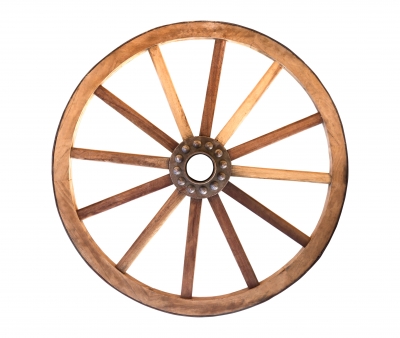
“Wooden Cartwheel” Image courtesy of Stoonn/ FreeDigitalPhotos.net
When we think about the invention of the wheel, the picture that jumps into our minds is the wheel from a car or maybe an ancient Roman chariot. The earliest wheels, however, were much different than 21st century wheels or even those used in first century battles.
The wheel was invented by the ancient Sumerians. They lived in the land between the Tigris and the Euphrates Rivers in the Middle East. Much, much later this land became part of the country we call Iraq. The Sumerians were the first people to develop a written language. Extensive studies of their writings have led archaeologists and historians to also credit them with the invention of the wheel. Continue reading
Posted in Blog, Engineering, Kids Blog, Kids: Engineering, Kids: Science and Tech, Science and Technology
Tagged ancient history, AntiquityNOW, Mesopotamia, Sumeria, wheel
The History in our Language: Idioms from Ancient Times, Part 2
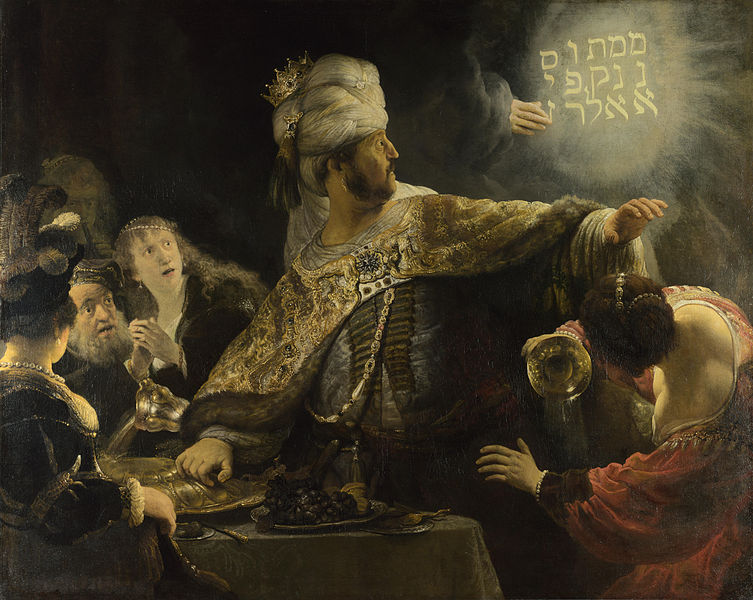
“Belshazzar’s Feast”, Rembrandt Van Rijn
Some of our common English sayings have a very ancient past. As a follow-up to The History in our Language: Idioms from Ancient Times, Part 1, here is Part 2 of idioms with ancient roots. Continue reading
Posted in Blog, Communications, Culture, Public Life
Tagged ancient history, AntiquityNOW, Babylon, Belshazzar, Daniel, idioms, language, Pandora, Zeus
The History in our Language: Idioms from Ancient Times, Part 1
*Originally published on February 7, 2013, this is the first post in our Ancient Idioms series. Don’t miss Part 2 on Thursday!
 It’s no secret that English is heavily influenced by Latin and Ancient Greek – especially if you’ve ever had to study vocab for the SATs – but it might surprise you to know that many of our current idioms have been around since ancient times. Idioms usually form based around the culture that speaks the language, yet the English language has several idioms that come from antiquity. They are a testament to how relevant history is to our lives today, and how we’re not so dissimilar to our ancient ancestors. Continue reading
Posted in Blog, Culture, Public Life
Tagged ancient history, AntiquityNOW, history, language
Ramadan Ends With Dishes That Celebrate the Heart of Palestinian Cuisine

Children perform in Jerusalem’s Old City during celebrations to mark the breaking of the fast on the seventh day of the holy month of Ramadan, on July 26, 2012. (Photo credit: AHMAD GHARABLI/AFP/GettyImages)
As Ramadan comes to a close, Muslims around the world are breaking their fasts and marking celebrations with family and friends. Ramadan is the 9th month of the Islamic calendar, although the dates change each year because the lunar and solar calendars are not exactly the same. The end of Ramadan occurs either 29 or 30 days from the beginning of the month, and is celebrated by the holiday of Eid ul-Fitr, where after morning prayers people exchange gifts, put up lights and decorations and feast on their favorite foods. The word Ramadan means scorching in Arabic and was designated as a Holy Month in honor of the Quran being revealed to the Prophet Muhammad in 610 CE. During Ramadan Muslims seek to purify themselves by forgoing material needs and focusing on spiritual devotion. They pray, read the Quran and carry out works of charity. Their self-denial of food and water helps them empathize with the less fortunate. Continue reading
Posted in Blog, Culinary, Culture, Public Life, Religion
Tagged ancient history, AntiquityNOW, Islam, Palestine, Ramadan
KIDS’ BLOG! Hot Fudge Sundae: A Dessert 5,000 Years in the Making
 So how much do you like ice cream? Ice cream with hot fudge…ice cream with sprinkles…ice cream with gumdrops…there really are many varieties and toppings. Let’s see how these ice cream treats were invented, beginning 5,000 years ago in China! Continue reading
Posted in Culinary, Culture, Kids Blog, Kids: Culinary, Kids: Culture
Tagged ancient history, AntiquityNOW, candy China, gumdrops, hot fudge, ice cream, sprinkles, whipped cream




 AntiquityNOW