
 Monday, March 17th is St. Patrick’s Day and regardless of nationality many people will don their greenest outfit and celebrate with a pint of green beer. Some may even enjoy a meal of corned beef and cabbage with potatoes, a traditional Irish feast. However, if you want to celebrate in a truly authentic Irish way, throw out the green beer, ignore those potatoes and have some ancient Irish food. The fact is, although the potato is often associated with Ireland, it is actually Peruvian and only came to Ireland in the early 1600s. And green food coloring in your beer won’t bring you any closer to the heart of the Irish. Enjoy some oatcakes with butter and a tall glass of milk and you’ll be sitting down to a meal the Irish have eaten for thousands of years. Continue reading
Category Archives: Culture
Bon Appetit Wednesday! Celebrate St. Patrick’s Day With Ancient Irish Oatcakes
The Disneyfication of Pocahontas and the True Story of Uleleh
 The story of Pocahontas has all the elements of a good drama: danger, the threat of great cruelty, bravery, a hint of romance and prevailing mercy. Who doesn’t like to imagine a beautiful young Native American princess shielding a handsome English soldier just as a warrior’s club is raised to deliver a deadly blow? Continue reading
Posted in Art, Blog, Celebrities, Culture, Human Rights, Public Life, Recreation
Tagged ancient history, AntiquityNOW, Disney, Hernando DeSoto, John Smith, Juan Ortiz, native american, Pocahontas, Uleleh
AntiquityNOW Celebrates International Women’s Day

*Click here to see a slideshow of remarkable women throughout history featuring music by the 12th century female composer Hildegard von Bingen.
Posted in Blog, Culture, Holidays, Public Life
Tagged ancient history, ancient women, AntiquityNOW, Hatshepsut, International Women's Day, Mae Jemison
Nanotechnology and the Ancient Romans: A Breakthrough 1,600 Years in the Making

Lycurgus Cup
The jade-green chalice with its delicately etched image of King Lycurgus entangled in grapevines is a stunning example of Roman glassmaking. But only upon closer examination can the observer appreciate the true innovation of these Roman artists—their use of nanotechnology. Continue reading
Posted in Art, Blog, Culture, Engineering, Science and Technology, Science Fiction
Tagged ancient history, AntiquityNOW, British Museum, dichroic glass, Dionysus, Lycurgus Cup, nanoparticles, nanotechnology, Roman
Bon Appetit Wednesday! Stay Warm With Fasolada, a Lenten Bean Soup Courtesy of Ancient Greek Farmers
 Today is Ash Wednesday, the first day of Lent, a time of preparation leading up to Easter observed by Christians around the world. It lasts for approximately six weeks and is marked by self-denial and abstaining from various foods. Meat is traditionally forbidden during this time. Fasolada, or Greek bean soup, is served during Lent because it is meatless but full of protein and nutrition. While this dish is perfect for the Lenten season, it is often enjoyed year-round and has a rich and ancient history. Continue reading
Posted in Blog, Bon Appetit Wednesday, Culinary, Culture, Public Life, Religion
Tagged Ancient Greece, ancient history, ancient recipes, AntiquityNOW, Ash Wednesday, beans, Bon Appetit Wednesday, fasolada, Lent
Bon Appetit Wednesday! Ancient Bitters, Modern Cocktails
 When you think of the five basic tastes – salty, sweet, sour, bitter and umami, a more recent addition approximating a savory or “meaty” flavor – bitter probably isn’t your favorite. And you’re not alone if you’d prefer salty, sweet, sour or savory. The debate over whether bitter is bad has raged since prehistory. Continue reading
Posted in Blog, Bon Appetit Wednesday, Culinary, Culture, Healing Arts, Science and Technology
Tagged alcohol, amaro, ancient history, AntiquityNOW, bitters, bitters tonic, Bon Appetit Wednesday, cocktails, flavors, umami
The Ancient Roots of February, the Tiniest Month
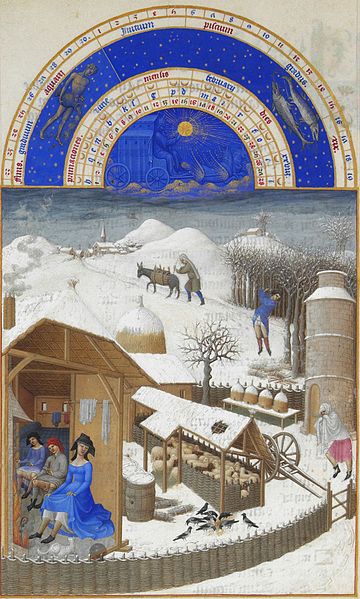
Très Riches Heures du duc de Berry Folio 2, verso: February. Artist: Limbourg brothers (1385–1416).
Why does February have only 28 days? Why does this one lonely month remain truncated while the other 11 months bask in the fullness of their 30 or 31 days? We have to go all the way back to antiquity to find the answer to this puzzling question.
The roots of our modern calendar can be traced back to the Romans who apparently found calendar-making to be a fairly confusing business. We have few records about the original Roman calendar but legend says that Romulus, the first king of Rome, devised a 10 month lunar calendar that began in March and ended with December, with 6 months having 30 days and 4 having 31. There was no need for designating the extra months of what is now January and February since winter itself was unimportant to note by the Romans because there was no harvest during this time.[1] According to Livy’s The Early History of Rome, Numa Pompilius, the second king of Rome (715-673 BCE), wanted to make a calendar that would sync with the actual lunar year and so he added the months of January and February to account for the extra days.[2] The length of each month was changed so that October retained 31 days, the remaining months from the previous calendar had 29 days, and January and February each had 28 days. However, the Romans believed even numbers were bad luck and so they added a day to January to give it 29. Why didn’t they also add an extra day to February? No one is really sure of the answer to that question but because February still had only 28 days, it was considered unlucky and was devoted to purification rights and honoring the dead.[3] Continue reading
Bon Appetit Wednesday! Ancient Russian Blini: Oh So Savory and Oh So Sweet
 It’s the second week of the Winter Olympics being held in Sochi, Russia and the competition is fierce as each country strives to up their medal count before the closing ceremonies. Maybe you’re planning a big closing ceremonies party or maybe you just need something to munch while you cheer on your favorite athlete. Perhaps you’re in a festive mood. Maslenitsa is a traditional holiday in Russia celebrated from February 24th – March 2nd. We’ll get to that in a bit. Either way, this week’s recipe is sure to please. In honor of Mother Russia, we’re exploring the ancient origins of Russian blini. We’re going to give you two modern blini recipes, one savory and one sweet, so you’ll be prepared no matter what you’re craving. Continue reading
Posted in Blog, Bon Appetit Wednesday, Culinary, Culture, Holidays, Public Life
Tagged ancient history, AntiquityNOW, blini, Bon Appetit Wednesday, Maslenitsa, pancakes, Russia, savory and sweet, Winter Olympics
Happy Valentine’s Day! The Power of Love (Pssst—It’s All in the Eyes and Nose)
 Red roses are synonymous with love, and have been for centuries. But there’s an interesting story behind the tales of starry-eyed lovers and their proclamations of everlasting romance. The red rose it seems, has as much to do with our eyes and nose as it has to do with affairs of the heart.
First, let’s take a look at the flower that started it all: the beauteous and aromatic rose. Roses can be traced back 35 million years according to fossil evidence. Roses were growing wild in many places as diverse as Persia and in what is now Colorado in the United States. As early as the 11th century BCE the Chinese were cultivating flowers of all sorts. In fact, China has incredible biodiversity and boasts 93 species and 144 varieties of roses that are native to its habitats.[1] China became the dominant breeder and purveyor of roses until around 300 years ago, when Europe took the lead in cultivation and breeding.[2] Continue reading
Posted in Anatomy and Physiology, Beauty, Biology, Blog, Culture, Holidays, Public Life, Recreation, Science and Technology
Tagged ancient history, AntiquityNOW, china, Isis, limbic system, Napoleon, red rose, romance, valentine's day
Bon Appetit Wednesday! Celebrate an Olympic-Sized Love with Ancient Cheesecake
 It’s that time of year again. Love is in the air as candied hearts and boxes of chocolates pack the shelves. This year Valentine’s Day falls in the middle of the Winter Olympics. Maybe you and your sweetheart are looking to celebrate love as you continue to cheer on the international athletes. We have the perfect dessert for you! Continue reading
Posted in Blog, Bon Appetit Wednesday, Culinary, Culture, Public Life, Sports
Tagged ancient history, ancient recipes, AntiquityNOW, Bon Appetit Wednesday, cheesecake, Greece, Olympics, Rome, valentine's day




 AntiquityNOW