
 History can be difficult to understand. The way it is told and interpreted depends on the point of view of a person or a culture, the time period from which it is being viewed and a thousand other variables that affect what is actually perceived as the truth of history. One of the greatest tools for anyone wanting to learn more about the past is often overlooked. Maps do more than tell us how to get where we’re going. Maps give us visual representations of the past. They can illustrate growth and movement of civilizations, the spread of various cultures, patterns that repeat themselves throughout time and so much more. Today we’re bringing you some fantastic resources that will help to illuminate the past and explain it in ways you may never have considered. These are great sites to use on your own or in the classroom. Continue reading
Category Archives: Public Life
Maps, Part I: Defining and Explaining our Past, Present and Future
Bon Appetit Wednesday: Celebrating Germany’s National Soup Day!
 It’s National Soup Day in Germany. Time to break out your best potato, cabbage or lentil soup, cozy up to a toasty fire and warm your bones. But of course, soup isn’t just appreciated in Germany. It’s a dish enjoyed all over the world in thousands of variations. And it has been a food staple in many ancient civilizations. In honor of Germany’s holiday we’re bringing you a recipe for hearty Kartoffelsuppe (German Potato Soup) and offering a brief ancient history of soup. So sit back, grab a spoon and enjoy! Continue reading
Strata: Portraits of Humanity, Episode 1, “Sailing Canoe”
 We are pleased to bring you “Sailing Canoe,” the first documentary from our partner Archaeological Legacy Institute’s new series, Strata: Portraits of Humanity. This monthly half-hour video series is available online and on select cable channels. Strata is a showcase for unique and diverse stories about the world’s cultural heritage. Stories come from across the globe with segments produced by Archaeological Legacy Institute and dozens of producer and distributor partners around the world. Continue reading
King Tut Controversy: The Controversial Portrait of a Boy King

 Recently Zahi Hawass, prominent Egyptian archaeologist, spoke out against a high profile television program called Tutankamun: The Truth Uncovered produced for the BBC and Smithsonian Channel, saying it “reveals lies, not the truth.”[1] He points out that the reconstruction of the boy king’s face is completely distorted and not based on scientific evidence and that the characterization of his hips as “feminine” is also incorrect and not based in fact. Continue reading
KIDS’ BLOG! Blowing Their Tops: The Destructive History and Amazing Science of Volcanoes

Lava flow from Mount Kilauea. Image credit: Adrian Glover
UPDATE! This post was originally published on September 3rd, 2013. Right now an ancient volcano in Hawaii is causing a lot of trouble for residents. The Kilauea Volcano, located on the Big Island of Hawaii, is actually its youngest volcano, but that doesn’t mean it’s a baby by any stretch of the imagination. It is over 300,000 years old and has been constantly active since prehistoric times. It is one of the world’s most active volcanos and features prominently in many Polynesian legends, including the story of Pele, a volcanic goddess who is said to live in the Kilauea crater.[1] There is even archaeological evidence of the eruptions that have taken place since antiquity. Footprints frozen in time leave reminders of those who have lost their lives to this powerful force of nature.[2] Continue reading
A Primer on Democracy: Where to Learn More
 “Man’s capacity for justice makes democracy possible, but man’s inclination to injustice makes democracy necessary. ” –Reinhold Niebuhr [1]
Today is voting day for the general mid-term elections in the United States. In honor of Americans flexing their right to vote we’ve put together a list of great sites to visit to learn more about democracy throughout history. Continue reading
Halloween, “The War of the Worlds” and Why We Love Flying Machines
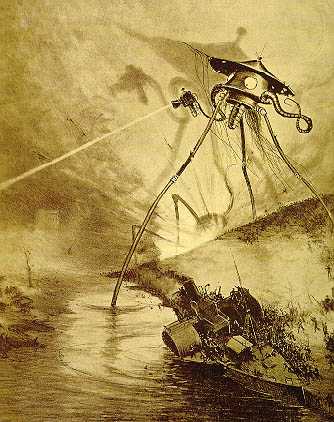
“War-of-the-worlds-tripod” by Henrique Alvim Correa,1906
Happy Halloween! AntiquityNOW has been celebrating Halloween this year with blog posts about doppelgangers, the origins of tricks and treats, modern and 2,000 year old ghost stories, and now, an original short story by author Victoria Weisfeld.
For inspiration Weisfeld draws from the legend of the events of October 31, 1938 when American producer, playwright and actor Orson Welles presented the CBS radio play, The War of the Worlds, adapted from the 1898 novel of the same name penned by British author H.G. Wells. The play centers around what happens when a Martian craft lands in the small, rural community of Grover’s Mill, New Jersey, which is the setting of Weisfeld’s short story. Continue reading
Posted in Blog, Celebrities, Culture, Holidays, Literature, Meteorology, Public Life, Religion, Science and Technology, Science Fiction
Tagged ancient aliens, ancient science fiction, ancient space ships, AntiquityNOW, H.G. Wells, Halloween, Mahabharata, Orson Welles, Ramayana, The War of the Worlds
The Colorful Past of Halloween Treats

Lads, look at yourselves. Why are you, boy, wearing that Skull face? And you, boy, carrying a scythe, and you, lad, made up like a Witch? And you, you, you!” He thrust his bony finger at each mask. “You don’t know, do you? You just put on those faces and old mothball clothes and jump out, but you don’t really know, do you? – Ray Bradbury (The Halloween Tree)
Remember the sweet satisfaction of a pillowcase, paper bag or plastic pumpkin-head swelling with the weight of Halloween candy? Think of the candy bars, lollipops and bubble gum mingling together in the monstrous payload you’ve been waiting all year to collect and consume in one riotous night of excitement. It’s so exciting in fact, that you may never pause to ponder why on earth you do it. What happy trick of fate empowered you to don a disguise and march up to strange doorways demanding treats? Continue reading
Posted in Blog, Crime, Culture, Holidays, Public Life, Recreation
Tagged All Hallows Eve, All Saints Day, Ancient Egypt, ancient history, AntiquityNOW, Aztecs, Celts, Dio de Los Muertos, guising, Guy Fawkes Day, Halloween, mumming, souling, trick-or-treat
Double Trouble: Doppelgangers and the Mythology of Spirit Doubles
 It’s almost Halloween! In our recent posts we’ve been delving into why some of us are so drawn to the supernatural, the paranormal and the scaring the pants off terrifying. In today’s post we hurl ourselves once more into the realm of the supernatural. A twice look at terror, as it were. Continue reading
Posted in Ancient Origins, Blog, Culture, Holidays, Literature, Psychology, Public Life, Religion, Science and Technology
Tagged ancient doppelgangers, ancient folklore, Ancient Origins, AntiquityNOW, doppelgangers, Egyptian mythology, Halloween, Native American mythology, Norse mythology, spirit doubles
A Frightful History: Author P J Hodge Presents “The Ghost Hunter”
 Last Tuesday’s blog explored the neurology of fear and introduced a 2000 year old horror story from Pliny the Younger. Despite its antiquity, this story (actually contained in a missive to an acquaintance by the prolific letter writer) exhibited remarkable 21st century elements. Today’s post is a short story titled “The Ghost Hunter.” Written by Paul Hodge, it is a modern take on storytelling in the gothic style. Notice the common elements with Pliny’s tale: the abandoned residence, unexplained occurrences and a man of doughty character determined to get to the bottom of whatever is going on. Continue reading




 AntiquityNOW