Category Archives: Public Life

Science Fiction or Uncovered Truth: The Enigmatic Origins of Crystal Skulls

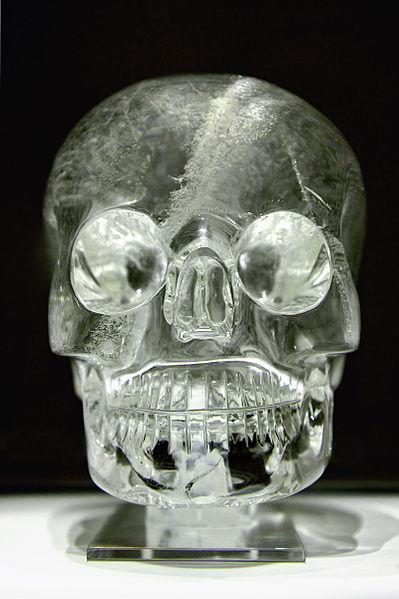
The crystal skull. Collection of the British Museum in London. Image courtesy of Rafał Chałgasiewicz

The crystal skull. Collection of the British Museum in London. Image courtesy of Rafał Chałgasiewicz

Another entry in AntiquityNOW’s new Science Fiction section is a story that has bedeviled skeptics and believers alike.  The origins and purpose of the crystal skulls have been debated for years, but Eric Vassalo, who submitted portions from his blog post on the subject to AntiquityNOW,  is a cynic regarding traditional inquiry.  He wanted to analyze for himself what these crystal skulls were all about.  As part of a group exploring sites containing these artifacts in Mexico, he mused:

Like a group of mutant X-men we all shared our fascinating and surreal stories of how we came to be in this place doing what so few dare to do, challenge our spoon-fed history and attempt to get at the truth.

Continue reading

AntiquityNOW Month and Ancient Horrors: Introducing Paul Hodge

This month we are premiering AntiquityNOW’s Science Fiction section. The horror story is a close relative of science fiction with today’s audiences, whether those tales of horror take place in outer space or a country churchyard.  With a nod to the enduring appeal of both genres, this tale by Paul Hodge conjures up ancient folklore (going back to Mesopotamia and ancient Greece and Rome) and a sense that death is sometimes not all that it appears to be.

paul hodge

Paul (P.J.) Hodge

Paul Hodge left London and came to reside in Hampshire armed with the collected works of MR James, Kate Bush and Nigel Kneale. He now trawls the dusky corners of the country seeking stories to entertain (and scare). These form part of his own collected works and blog, Freaky Folk Tales. Hodge will also be contributing his imaginative stories to Today’s Muse, AntiquityNOW’s creative section.

Enjoy his tale The Churchyard Horror below. Continue reading

May the Force Be With You: AntiquityNOW Celebrates International Star Wars Day

starWarsDay Marking this day, AntiquityNOW is launching a Science Fiction section on antiquitynow.org to explore how ancient motifs have influenced this popular genre.   

Today is International Star Wars Day.  May the Force (that’s right, it’s a spin on May 4th) be with you.  What is the enduring power of these movies?  Is it the storytelling, the intergalactic characters or perhaps the dazzling visuals? Yes to all.  But there is more at play. George Lucas, the creator of the Star Wars series, has spoken frequently of how his personal interest in the metaphysical has informed his movie-making. Having been a long-time friend of the late American mythologist Joseph Campbell, Lucas found a mystical purpose in the magic of film.  “I’m telling an old myth in a new way,”[1] he said in a 1999 interview about Star Wars with PBS TV’s Bill Moyers. He describes this telling as a “kind of immaculate realism in a totally unreal and fantasy world.”[2] Many have suggested that his films are embedded with a religious undercurrent. But Lucas professes the most ecumenical embrace of spiritual ideals and dismisses any ties with a particular religion. For example, the Force was never intended to represent a specific religion, but rather a catalyzing idea that could awaken young people to the possibilities of a spiritual life.  He wanted them to question and seek their own perspectives of the unseen world.[3]Yet his dialog can seem profoundly religious and even vaguely familiar to those who are among the faithful.  As the powerful Jedi master Yoda said: Continue reading

Cheers! It’s AntiquityNOW Month: Celebrate With Beer, the Most Feminine of Beverages

beer

May is AntiquityNOW Month.  Throughout the next four weeks we will bring you stories about the surprising ways that antiquity lives today.  And to get in the mood, here’s a take on the beer-swilling antecedents that have united us through the millennia.  (Click here for suggestions for teachers and everyone else on ways to celebrate AntiquityNOW Month.)

Cheers! National Homebrew Day in the United States is this Saturday, but before you sip, take a good look at that golden liquid and know that if it weren’t for women, the bubbly elixir would likely be nothing but a musty pile of grain. The beer industry today is dominated by men. Women account for only 10 percent of professional brewers, and represent just a sliver of all homebrewers.[1] But ancient history reveals that, as far back as 4,000 years ago (and probably further), brewing was done primarily by women. Continue reading

Archaeology in the Community: Introducing New Generations to the Mysteries of Ancient Lives

Archaeology in the Community logoWhat do you do when you realize that there are children who never heard of archaeology? Children who have never seen an archaeologist or know why archaeology even exists? If you are Dr. Alexandra Jones, you create an organization that reaches into those communities to show young people what this amazing field of discovery is all about. Continue reading

It’s National Poetry Month! Ancient Poetry and the Created Self: From Early Epics to Afghan Women’s Landays

Marble terminal bust of Homer. Roman copy of a lost Hellenistic original of the 2nd c. BC. From Baiae, Italy. In the British Museum.

Marble terminal bust of Homer. Roman copy of a lost Hellenistic original of the 2nd c. BC. From Baiae, Italy. In the British Museum.

Throughout time, poetry has been one of the most evocative of art forms.  From ritual chanting and epic histories to love sonnets and modern free verse, poetry has represented the essence of what it is to be human.  Since April is National Poetry Month in the United States, let’s take a look at the origins of this artistic device.  As well, we’ll observe a unique poetry tradition recast with a 21st century perspective. We’ll see how poetry is giving voice to women in Afghanistan, who as with early cultures that forged their identities in verse, are tapping the extraordinary power of poetry to create their own sense of “self.” Continue reading

A Place Called Home: Earth Day, Ecopsychology and an Urban Legend

earth_day_2010_by_CrypticDisdain

What is this connection with the earth that we humans cling to so tenaciously?  As a species we obviously are dependent on the air to breathe, the water and soil that nurture us, the sun whose fiery presence holds us in its eternal circle.  But the earth is more than the elements that give us life.  The earth holds millions of memories in the folds of its mountains, across the tapestry of its lands and in the rhythmic singing of its seas. For we as humans attach ourselves to this earth, not just for nurturance, but by the profound evocations of time, memory and place. Continue reading

Easter, Resurrection and Chocolate Bunnies: Social Marketing Through the Ages

Image courtesy of Toelstede (Wikipedia-Name Nyks).

Image courtesy of Toelstede (Wikipedia-Name Nyks).

Easter is one of the holiest of holidays for Christians.   And with Easter’s roots in antiquity, we can see why the symbolism of this holiday continues to give succor and hope to believers today. But Easter is also a holiday that resonates for secular audiences.  You just have to know your market.

Easter derives its name from Eostre, an Anglo-Saxon goddess of spring. As happened with many pagan holidays, early Christians saw an opportunity.  Around the second century CE they began absorbing Eostre’s meaning into their own story of Christ’s death and resurrection.  It was the holiday that spoke to the core of the human experience:  that death was merely transitory and that life—whether in this world or the next–prevailed.  So the most heralded and cherished concept of the Christian faith became entwined with Eostre, which itself commemorated life triumphing over death.  By correlating the stories over time, the fledgling Christian church not only gained a popular holiday, but also converts.  Forget today’s marketing calibrations for brand loyalty, return on investment and predictive validity.  This early social marketing by enterprising Christians is a case study of excellence in branding.  What better than a holiday celebrating life over death?  What smarter business plan than capitalizing on the success and market share held by your competitor, in this case, Eostre celebrants? Continue reading

Bon Appetit Wednesday! Green Borscht With Matzah for a Multi-Cultural Passover

Green nettle soup in a bowl with a spoon isolated on white background

Monday night, April 14th, was the first night of Passover, the eight-day festival celebrated by Jews around the world to commemorate the emancipation of the Israelites from slavery in ancient Egypt. The start of the holiday always corresponds to the 15th day of the Hebrew month of Nissan. Continue reading

May Is AntiquityNOW Month! Join the Celebration!

AN Month bigWhen we considered a commemoration in 2013, we asked ourselves a question:  Why have an AntiquityNOW month?   The answer was in our mission: to show how antiquity’s legacy influences us today and for generations to come.  So for the month of May, we will laud human endeavor through the ages and mark the importance of our world heritage. Continue reading