
Category Archives: Public Life
ImageBon Appetit Wednesday! Slow-Cooked, Mustard-Crusted Pork Loin
 For many families, the Christmas feast is not complete without the Christmas ham. Did you know that the traditional Christmas ham was not originally associated with Christmas at all, but like so many other holiday traditions, grew out of ancient pagan practices? Continue reading
Posted in Blog, Bon Appetit Wednesday, Culinary, Culture, Holidays, Public Life
Tagged ancient history, AntiquityNOW, boar, Freyr, Norse mythology, yule log, Yuletide
Merry Christmas! The History—and Neuroscience—of Christmas Caroling
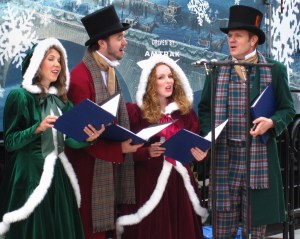
Image courtesy of deltamike on Flickr.
Caroling has been a popular pastime to celebrate Christmas for hundreds of years. Indeed, chanting and song have been a part of rituals and celebrations from some of the earliest of societies. Whether found in the first hollowed bone flute and percussive tree stump or the widely stylized play lists of today, music has been embedded in human culture. And as contemporary studies show, our responses to music are not just attuned to auditory preferences and social context. Music is really a “brain thing.” Continue reading
Bon Appetit Wednesday! Happy Holidays! Enjoy an Eggnog Courtesy of Your Ancestral Genes

Image courtesy of Reese Lloyd on Flickr.
Eggnog is a holiday beverage with a history and a taste that can’t be beat. To really appreciate the roots of eggnog, we have to go back 7,500 years. That was a period critical to the human species—or at least to those of us who indulge in dairy. It was sometime during that period that humans in the region between the central Balkans and central Europe developed “lactase persistence.” Professor Mark Thomas of University College London (UCL) Genetics, Evolution and Environment says in a 2009 study, “Most adults worldwide do not produce the enzyme lactase and so are unable to digest the milk sugar lactose. However, most Europeans continue to produce lactase throughout their life, a characteristic known as lactase persistence. In Europe, a single genetic change (13,910*T) is strongly associated with lactase persistence and appears to have given people with it a big survival advantage.” Continue reading
The History of the Holiday Evergreen
 This is the time of year where evergreens are festively decked out in red ribbon and twinkling lights and festooning homes and cities around the globe. But did you know you were following in the footsteps of ancient cultures from all over the world who used green plants in their own winter solstice celebrations? Beginning thousands of years ago and culminating in today’s ubiquitous Christmas tree, greenery has long been a cherished holiday decoration. Continue reading
Posted in Blog, Holidays, Public Life, Religion
Tagged ancient history, AntiquityNOW, Celtic Druids, Christmas, Christmas tree, date palm, evergreen, holidays, Ra, Saturnalia, winter solstice, Yuletide
The Pagan Origins of Christmas
 In the modern age, the majority of the world view Christmas as a Christian holiday in origin. However, this is not the case. A lot of popular traditions that are associated with Christmas are not indeed Christian in origin. Many have pre-Christian beginnings in pagan festivals that were celebrated by the pagan populace around the winter solstice before they were later converted to Christianity. Examples of such festivals are Saturnalia and Yule. In addition to this, Christmas was banned on a few occasions within certain Protestant groups, such as the Puritans, because they believed that Christmas was too pagan.[1] In modern times Christmas, for those who celebrate it, is generally thought to be most people’s favourite holiday. The same could be said for the pagan winter festivals in ancient Europe. This was due to the fact that everyone was looking forward to better weather with the arrival of Spring and that there was far less agricultural work to be done at this time of year. Continue reading
Posted in Blog, Holidays, Public Life, Recreation, Religion
Tagged ancient history, AntiquityNOW, Koliada, Odin, pre-Christian Germanic, Romans, Saturn, Saturnalia, Sol, yule log, Yule Tide
Bon Appetit Wednesday! St. Nicholas or Santa Claus? A Cookie Is Still As Sweet….
Below are two cookie recipes: one in honor of St. Nick and the other Santa Claus. For those of you who have a healthy dose of curiosity as well as a sweet tooth, let’s explore how these two holiday figures came to be.
St. Nicholas was a bishop in southwestern Turkey in the 4th century. Born to a wealthy family, he gave much of his money away in support of the poor. As the bishop of Myra, he had a number of miracles attributed to him and was eventually declared a saint. His feast day was celebrated on December 6th. During St. Nicholas’ lifetime, Pope Julius I decided that Jesus should be given a day that could be celebrated in honor of his birth. Because the winter solstice was already being celebrated, the birthday for Jesus was designated to coincide, which eventually proved successful in “Christianizing” the previously pagan holiday. Over time St. Nicholas’ day and Jesus’ birthday became associated, and the Christmas tradition began. Because St. Nicholas was beneficent in his offerings to the poor, stuffed stockings and gifts became synonymous with this day. Continue reading
Posted in Blog, Bon Appetit Wednesday, Celebrities, Culinary, Culture, Holidays, Public Life, Religion
Tagged ancient history, AntiquityNOW, Christmas, Dutch, holidays, Jesus, Saint Nicholas, Sancte Claus, Santa Claus, Sinter Klaus
Reminder: LegacyQuest Letters of Intent Due December 13
*Here’s the blog we ran a while back announcing LegacyQuest, the International Children’s Film and Video Festival that will be held during AntiquityNOW Month in May 2014. Please contact Shirley K. Gazsi, president of AntiquityNOW, at sgazsi@antiquitynow.org to discuss any ideas or if you have questions about an entry. We look forward to your submissions!

Discovering the secrets of past lives can often defy conventional wisdom and astound our modern sensibilities. With this in mind, AntiquityNOW (AN) and Archaeological Legacy Institute (ALI) are launching the first LegacyQuest International Children’s Film and Video Festival open to young people between the ages of 12 and 15 (6th – 8th grades) in the United States and abroad. It will be held in conjunction with The Archaeology Channel (TAC) International Film and Video Festival, May 9-13, 2014, in Eugene, Oregon, USA.
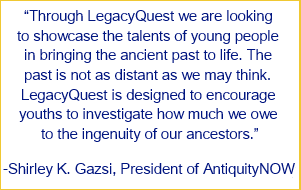 Young people are encouraged to submit videos or films that represent antiquity’s legacy in contemporary life. For example, students may show how today’s green technology has roots in ancient people’s use of thermal energy and wind power to heat their homes and pump their water. Creative and varied perspectives of historical and modern connections can be captured in any form, including documentary, narrative and journalistic, as well as interpretive styles using music or art. Continue reading

Bon Appetit Wednesday! Roasted Leeks and Apples: A Thanksgiving Savory and Sweet
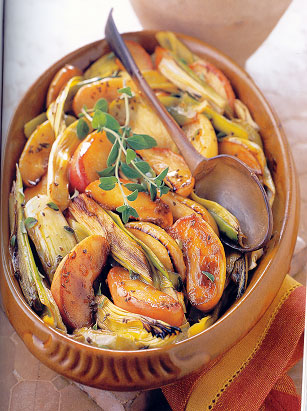 This modern dish is a delightful savory and sweet combination that uses two popular ingredients: leeks and apples. It can be served as a side dish to any entrée.
The leek and apple have nourished people for thousands of years. Both have been cultivated across the world and enriched our mythology and literature with symbolism. Continue reading
Posted in Blog, Bon Appetit Wednesday, Culinary, Culture, Holidays, Public Life, Religion
Tagged Agatha Christie, ancient history, AntiquityNOW, apples, Bon Appetit Wednesday, leeks, Nero, recipe, Rosh Hashanah, Thanksgiving



 AntiquityNOW