
 Today is Ash Wednesday, the first day of Lent, a time of preparation leading up to Easter observed by Christians around the world. It lasts for approximately six weeks and is marked by self-denial and abstaining from various foods. Meat is traditionally forbidden during this time. Fasolada, or Greek bean soup, is served during Lent because it is meatless but full of protein and nutrition. While this dish is perfect for the Lenten season, it is often enjoyed year-round and has a rich and ancient history. Continue reading
Category Archives: Public Life
Bon Appetit Wednesday! Stay Warm With Fasolada, a Lenten Bean Soup Courtesy of Ancient Greek Farmers
Posted in Blog, Bon Appetit Wednesday, Culinary, Culture, Public Life, Religion
Tagged Ancient Greece, ancient history, ancient recipes, AntiquityNOW, Ash Wednesday, beans, Bon Appetit Wednesday, fasolada, Lent
Music, Color, Costumes and Beads—It’s Mardi Gras Time!

Mardi Gras in New Orleans, 1936.
Did you know that Mardi Gras has ancient roots? Come back with us to those bygone times and explore the festivities that have led to the sights and sounds of today’s modern-day celebration in New Orleans.
First, the vocabulary surrounding Mardi Gras and Carnival bears some explanation. The period between January 6, or the Epiphany (ending the twelve days of Christmastide) to Ash Wednesday is the Carnival season, which is based on Christian rituals. It precedes Lent, a roughly six-week period of sacrifice and prayer prior to Easter Sunday. Mardi Gras technically is the last day of the Carnival and is held on Fat Tuesday (although the Mardi Gras season is an accepted term often heard). In fact, the word “carnival” is thought to be from the “Medieval Latin word carnelevarium, meaning to take away or remove meat.”[1] Continue reading
Posted in Blog, Holidays, Public Life, Recreation, Religion
Tagged ancient history, AntiquityNOW, Bacchus, Carnival, Fat Tuesday, Lent, Mardi Gras, New Orleans, Roman mythology
The Ancient Roots of February, the Tiniest Month
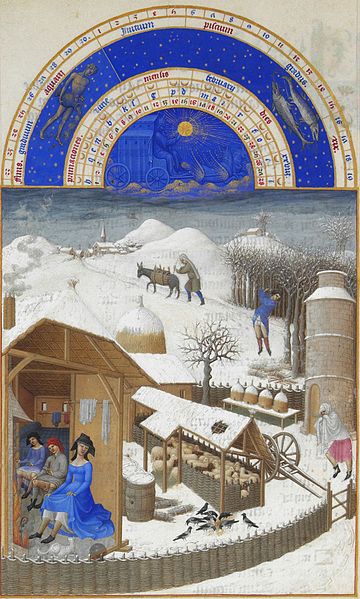
Très Riches Heures du duc de Berry Folio 2, verso: February. Artist: Limbourg brothers (1385–1416).
Why does February have only 28 days? Why does this one lonely month remain truncated while the other 11 months bask in the fullness of their 30 or 31 days? We have to go all the way back to antiquity to find the answer to this puzzling question.
The roots of our modern calendar can be traced back to the Romans who apparently found calendar-making to be a fairly confusing business. We have few records about the original Roman calendar but legend says that Romulus, the first king of Rome, devised a 10 month lunar calendar that began in March and ended with December, with 6 months having 30 days and 4 having 31. There was no need for designating the extra months of what is now January and February since winter itself was unimportant to note by the Romans because there was no harvest during this time.[1] According to Livy’s The Early History of Rome, Numa Pompilius, the second king of Rome (715-673 BCE), wanted to make a calendar that would sync with the actual lunar year and so he added the months of January and February to account for the extra days.[2] The length of each month was changed so that October retained 31 days, the remaining months from the previous calendar had 29 days, and January and February each had 28 days. However, the Romans believed even numbers were bad luck and so they added a day to January to give it 29. Why didn’t they also add an extra day to February? No one is really sure of the answer to that question but because February still had only 28 days, it was considered unlucky and was devoted to purification rights and honoring the dead.[3] Continue reading
Bon Appetit Wednesday! Ancient Russian Blini: Oh So Savory and Oh So Sweet
 It’s the second week of the Winter Olympics being held in Sochi, Russia and the competition is fierce as each country strives to up their medal count before the closing ceremonies. Maybe you’re planning a big closing ceremonies party or maybe you just need something to munch while you cheer on your favorite athlete. Perhaps you’re in a festive mood. Maslenitsa is a traditional holiday in Russia celebrated from February 24th – March 2nd. We’ll get to that in a bit. Either way, this week’s recipe is sure to please. In honor of Mother Russia, we’re exploring the ancient origins of Russian blini. We’re going to give you two modern blini recipes, one savory and one sweet, so you’ll be prepared no matter what you’re craving. Continue reading
Posted in Blog, Bon Appetit Wednesday, Culinary, Culture, Holidays, Public Life
Tagged ancient history, AntiquityNOW, blini, Bon Appetit Wednesday, Maslenitsa, pancakes, Russia, savory and sweet, Winter Olympics
It’s a 3D Life: Using Minecraft to Recreate Antiquity
 It’s a strange world of 3D cubes that comprise environments both hauntingly beautiful and brutally harsh. Rivers flow through peaceful meadows, deserts and jungles teem with hidden dangers and mountains loom in awe-inspiring splendor. For the high school students in Peter Albert’s class at The Hun School, a private academy in Princeton, NJ, Minecraft is a fantasy computer game with considerably high stakes and a provocative underlying premise. In this 3D virtual habitat, students confront a primal question: Do you have what it takes to survive? Continue reading
Happy Valentine’s Day! The Power of Love (Pssst—It’s All in the Eyes and Nose)
 Red roses are synonymous with love, and have been for centuries. But there’s an interesting story behind the tales of starry-eyed lovers and their proclamations of everlasting romance. The red rose it seems, has as much to do with our eyes and nose as it has to do with affairs of the heart.
First, let’s take a look at the flower that started it all: the beauteous and aromatic rose. Roses can be traced back 35 million years according to fossil evidence. Roses were growing wild in many places as diverse as Persia and in what is now Colorado in the United States. As early as the 11th century BCE the Chinese were cultivating flowers of all sorts. In fact, China has incredible biodiversity and boasts 93 species and 144 varieties of roses that are native to its habitats.[1] China became the dominant breeder and purveyor of roses until around 300 years ago, when Europe took the lead in cultivation and breeding.[2] Continue reading
Posted in Anatomy and Physiology, Beauty, Biology, Blog, Culture, Holidays, Public Life, Recreation, Science and Technology
Tagged ancient history, AntiquityNOW, china, Isis, limbic system, Napoleon, red rose, romance, valentine's day
Bon Appetit Wednesday! Celebrate an Olympic-Sized Love with Ancient Cheesecake
 It’s that time of year again. Love is in the air as candied hearts and boxes of chocolates pack the shelves. This year Valentine’s Day falls in the middle of the Winter Olympics. Maybe you and your sweetheart are looking to celebrate love as you continue to cheer on the international athletes. We have the perfect dessert for you! Continue reading
Posted in Blog, Bon Appetit Wednesday, Culinary, Culture, Public Life, Sports
Tagged ancient history, ancient recipes, AntiquityNOW, Bon Appetit Wednesday, cheesecake, Greece, Olympics, Rome, valentine's day
KIDS’ BLOG! Ancient Origins of the XXII Winter Olympics
 When the Greeks gathered in Olympia for the first Olympic Games in 776 BBC, I’m sure they never imagined that one day, far in the future, the Games would be held high in snow covered mountains or on playing fields made of ice. How could they know that their foot races would turn into races on blades (speed skating) and chariot races would become daring flights around a track made of pure ice (bobsled)? In 1924, the first Winter Olympics was held in Chamonix, France featuring cold-weather sports. Today we celebrate these Winter Games every four years. Did you know that just like the Olympic Games themselves, many of the winter sports have ancient and historical origins? Continue reading
Posted in Blog, Holidays, Kids Blog, Kids: Holidays, Kids: Public Life, Kids: Recreation, Kids: Sports, Public Life, Recreation, Sports
Tagged ancient history, AntiquityNOW, curling, Egypt, Ethiopia, ganna, Greece, ice hockey, ice skating, luge, Mesoamerica, Norway, Olympia, Olympics, Russia, skiing, Sweden, winter sports
The Egyptian Uprising and the Future of Antiquity: An Interview with Zahi Hawass
 For years Zahi Hawass was a superstar among Egyptologists and one would say, archaeologists in general. Even those who weren’t archaeologists or in related fields were familiar with him. Not only did he have his own program on the History Channel, he appeared frequently on shows on the Discovery and National Geographic channels. He was an author and a passionate advocate for cultural preservation. Held in favor by the Egyptian government—even appointed as the Minister of Antiquities in 2011 by President Hosni Mubarak—he was lauded for raising Egypt’s profile in the world. However, fortune and politics can be lethal twins. After the toppling of the Mubarak government, Hawass became a persona non grata in his own country. He lost his TV show, was arrested by the Egyptian government (and later released) and was heaved unceremoniously out of his office and the spotlight. And with the ongoing unrest in Egypt, he has much to ponder as to the future of his country and the fate of Egyptian heritage. Continue reading
Posted in Blog, Celebrities, Crime, Culture, Education, Human Rights, Politics, Public Life, War and Violence
Tagged ancient history, antiquities, AntiquityNOW, archaeology, cultural preservation, Egypt, Egyptology, Hosni Mubarak, interview, looting, Zahi Hawass
Super Bowl 2014 and Aztec Chocolate Caramel Popcorn—Sweet Victory All Around

Image courtesy of marsmet522.
Bon Appetit Wednesday! on January 22 showcased this recipe—strategically posted between National Popcorn Day and the National Football League’s Super Bowl XLVIII in the United States—and described the relationship between the Aztecs, popcorn and chocolate. In honor of the Super Bowl being played today, we are re-posting the recipe for the football parties being held far and wide. But so you know, fans of the Denver Broncos and Seattle Seahawks may want to take a page from Aztec sporting history as kickoff approaches. Continue reading
Posted in Blog, Culinary, Culture, Holidays, Public Life, Recreation, Sports
Tagged American football, ancient history, AntiquityNOW, Aztec, Mesoamerica, Olmec, sports, Superbowl, ullamaliztli




 AntiquityNOW