
 Last Thursday, March 20th, marked the much anticipated first day of spring. At 12:57 pm ET, the sun crossed the equator and the vernal equinox arrived. Many people cheered as winter met its official end, but the date had special significance for Persians. It was the beginning of the Persian New Year or Nowruz, a time for dancing, celebrating and most importantly, feasting! Each year the holiday begins with a special meal enjoyed around the haftseen table, where the foods are symbolic and abundant. In recognition of 2014’s haftseen table, we’re giving you a delicious Persian recipe from this traditional meal that you can enjoy in your home year-round. It’s never too late to celebrate and learn about the cuisine of an ancient culture! Continue reading
Category Archives: Religion
Bon Appetit Wednesday! Sabzi Polo Mahi in Honor of Persian New Year
Modern Technology Brings the Dead Sea Scrolls to Life
 The discovery of the Dead Sea Scrolls is undisputedly one of the most important archaeological moments of the last several centuries. In 1947 hundreds of ancient scrolls, including the oldest copy of the Hebrew Bible were found in a remote Judean Desert cave giving us an unprecedented insight into the society, religion and language during the Second Temple Period. To gaze upon and study these scrolls is an incredible opportunity that few have had up to this point. However, thanks to a collaboration between Google and the Israeli Antiquity Authority, anyone with an internet connection is now able to view these stunning pieces of history in high definition. Using the most advanced and innovative imaging technology, the IAA has imaged and uploaded the scrolls to a public online digital library and they’ve recently revamped their website to make the experience even more user-friendly. Technology is once again giving us the ability to understand and appreciate our past. Continue reading
Posted in Blog, Communications, Computer Technology, Culture, Education, Literature, Public Life, Religion, Science and Technology
Tagged ancient history, AntiquityNOW, Christianity, Dead Sea Scrolls, Essene, Google, Israeli Antiquity Authority, Judaism, Leon Levy Digital Library, multispectral imaging, Qumran
St. Patrick’s Day, Leprechauns and Human Folly

Image courtesy of jpmpinmontreal on Flickr.
So it’s the wearin’ of the green time again. In the United States (which in the 18th century took a religious holiday and turned it into a green phenomenon) it’s when everyone claims Irish ancestry for the day. Just look around and see all things Irish today: green bagels, green beer, green cupcakes and even a green Chicago River. Continue reading
Posted in Blog, Holidays, Literature, Public Life, Recreation, Religion
Tagged ancient history, AntiquityNOW, faeries, green, Ireland, leprechauns, St. Patrick, St. Patrick's Day
Bon Appetit Wednesday! Stay Warm With Fasolada, a Lenten Bean Soup Courtesy of Ancient Greek Farmers
 Today is Ash Wednesday, the first day of Lent, a time of preparation leading up to Easter observed by Christians around the world. It lasts for approximately six weeks and is marked by self-denial and abstaining from various foods. Meat is traditionally forbidden during this time. Fasolada, or Greek bean soup, is served during Lent because it is meatless but full of protein and nutrition. While this dish is perfect for the Lenten season, it is often enjoyed year-round and has a rich and ancient history. Continue reading
Posted in Blog, Bon Appetit Wednesday, Culinary, Culture, Public Life, Religion
Tagged Ancient Greece, ancient history, ancient recipes, AntiquityNOW, Ash Wednesday, beans, Bon Appetit Wednesday, fasolada, Lent
Music, Color, Costumes and Beads—It’s Mardi Gras Time!

Mardi Gras in New Orleans, 1936.
Did you know that Mardi Gras has ancient roots? Come back with us to those bygone times and explore the festivities that have led to the sights and sounds of today’s modern-day celebration in New Orleans.
First, the vocabulary surrounding Mardi Gras and Carnival bears some explanation. The period between January 6, or the Epiphany (ending the twelve days of Christmastide) to Ash Wednesday is the Carnival season, which is based on Christian rituals. It precedes Lent, a roughly six-week period of sacrifice and prayer prior to Easter Sunday. Mardi Gras technically is the last day of the Carnival and is held on Fat Tuesday (although the Mardi Gras season is an accepted term often heard). In fact, the word “carnival” is thought to be from the “Medieval Latin word carnelevarium, meaning to take away or remove meat.”[1] Continue reading
Posted in Blog, Holidays, Public Life, Recreation, Religion
Tagged ancient history, AntiquityNOW, Bacchus, Carnival, Fat Tuesday, Lent, Mardi Gras, New Orleans, Roman mythology
The Ancient Roots of February, the Tiniest Month
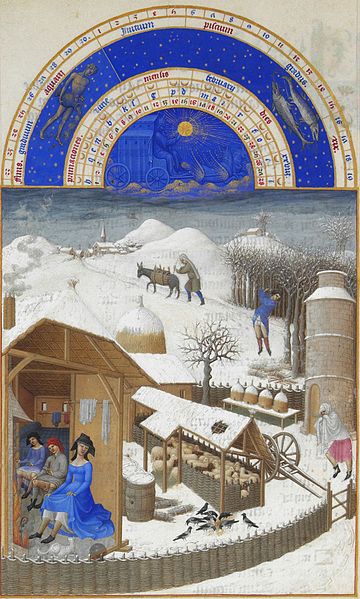
Très Riches Heures du duc de Berry Folio 2, verso: February. Artist: Limbourg brothers (1385–1416).
Why does February have only 28 days? Why does this one lonely month remain truncated while the other 11 months bask in the fullness of their 30 or 31 days? We have to go all the way back to antiquity to find the answer to this puzzling question.
The roots of our modern calendar can be traced back to the Romans who apparently found calendar-making to be a fairly confusing business. We have few records about the original Roman calendar but legend says that Romulus, the first king of Rome, devised a 10 month lunar calendar that began in March and ended with December, with 6 months having 30 days and 4 having 31. There was no need for designating the extra months of what is now January and February since winter itself was unimportant to note by the Romans because there was no harvest during this time.[1] According to Livy’s The Early History of Rome, Numa Pompilius, the second king of Rome (715-673 BCE), wanted to make a calendar that would sync with the actual lunar year and so he added the months of January and February to account for the extra days.[2] The length of each month was changed so that October retained 31 days, the remaining months from the previous calendar had 29 days, and January and February each had 28 days. However, the Romans believed even numbers were bad luck and so they added a day to January to give it 29. Why didn’t they also add an extra day to February? No one is really sure of the answer to that question but because February still had only 28 days, it was considered unlucky and was devoted to purification rights and honoring the dead.[3] Continue reading
The History of the Holiday Evergreen
 This is the time of year where evergreens are festively decked out in red ribbon and twinkling lights and festooning homes and cities around the globe. But did you know you were following in the footsteps of ancient cultures from all over the world who used green plants in their own winter solstice celebrations? Beginning thousands of years ago and culminating in today’s ubiquitous Christmas tree, greenery has long been a cherished holiday decoration. Continue reading
Posted in Blog, Holidays, Public Life, Religion
Tagged ancient history, AntiquityNOW, Celtic Druids, Christmas, Christmas tree, date palm, evergreen, holidays, Ra, Saturnalia, winter solstice, Yuletide
The Pagan Origins of Christmas
 In the modern age, the majority of the world view Christmas as a Christian holiday in origin. However, this is not the case. A lot of popular traditions that are associated with Christmas are not indeed Christian in origin. Many have pre-Christian beginnings in pagan festivals that were celebrated by the pagan populace around the winter solstice before they were later converted to Christianity. Examples of such festivals are Saturnalia and Yule. In addition to this, Christmas was banned on a few occasions within certain Protestant groups, such as the Puritans, because they believed that Christmas was too pagan.[1] In modern times Christmas, for those who celebrate it, is generally thought to be most people’s favourite holiday. The same could be said for the pagan winter festivals in ancient Europe. This was due to the fact that everyone was looking forward to better weather with the arrival of Spring and that there was far less agricultural work to be done at this time of year. Continue reading
Posted in Blog, Holidays, Public Life, Recreation, Religion
Tagged ancient history, AntiquityNOW, Koliada, Odin, pre-Christian Germanic, Romans, Saturn, Saturnalia, Sol, yule log, Yule Tide
Bon Appetit Wednesday! St. Nicholas or Santa Claus? A Cookie Is Still As Sweet….

Below are two cookie recipes: one in honor of St. Nick and the other Santa Claus. For those of you who have a healthy dose of curiosity as well as a sweet tooth, let’s explore how these two holiday figures came to be.
St. Nicholas was a bishop in southwestern Turkey in the 4th century. Born to a wealthy family, he gave much of his money away in support of the poor. As the bishop of Myra, he had a number of miracles attributed to him and was eventually declared a saint. His feast day was celebrated on December 6th. During St. Nicholas’ lifetime, Pope Julius I decided that Jesus should be given a day that could be celebrated in honor of his birth. Because the winter solstice was already being celebrated, the birthday for Jesus was designated to coincide, which eventually proved successful in “Christianizing” the previously pagan holiday. Over time St. Nicholas’ day and Jesus’ birthday became associated, and the Christmas tradition began. Because St. Nicholas was beneficent in his offerings to the poor, stuffed stockings and gifts became synonymous with this day. Continue reading
Posted in Blog, Bon Appetit Wednesday, Celebrities, Culinary, Culture, Holidays, Public Life, Religion
Tagged ancient history, AntiquityNOW, Christmas, Dutch, holidays, Jesus, Saint Nicholas, Sancte Claus, Santa Claus, Sinter Klaus
Bon Appetit Wednesday! Roasted Leeks and Apples: A Thanksgiving Savory and Sweet
 This modern dish is a delightful savory and sweet combination that uses two popular ingredients: leeks and apples. It can be served as a side dish to any entrée.
The leek and apple have nourished people for thousands of years. Both have been cultivated across the world and enriched our mythology and literature with symbolism. Continue reading
Posted in Blog, Bon Appetit Wednesday, Culinary, Culture, Holidays, Public Life, Religion
Tagged Agatha Christie, ancient history, AntiquityNOW, apples, Bon Appetit Wednesday, leeks, Nero, recipe, Rosh Hashanah, Thanksgiving




 AntiquityNOW