
 AntiquityNOW Month partner Girl Be Heard is fighting back against gun violence. 9mm America is a show written and performed by young girls living in neighborhoods where gun violence is a constant threat. One girl explains that her neighborhood is known as “4CD” or “the Four Corners of Death” because so many people have died there due to gun violence. Continue reading
“9mm America”: Girl Be Heard Uses Theater to Fight Gun Violence
Posted in Art, Blog, Culture, Education, Human Rights, Public Life
Tagged ancient history, AntiquityNOW, Girl Be Heard, gun violence, theater
2013 Winners of The Archaeology Channel International Film and Video Festival
 In our last blog post we told you about this year’s big winner at The Archaeology Channel’s International Film and Video Festival. The 2000 Year Old Computer took top honors in both the juried competition as well as the audience vote. However, this wasn’t the only film to snag an award. The 2013 festival was full of amazing entries. Here are a few of the winners in other categories: Continue reading
2013 Winner of The Archaeology Channel International Film and Video Festival Best Film
 The Archaeology Channel’s 2013 International Film and Video Festival just wrapped up and it was full of fantastic entries. The festival’s mission is:
“To exhibit for our audience the wonderful diversity of human cultures past and present in the exploration of our place in history and in our world. To promote the genre and the makers of film and video productions about archaeology and indigenous peoples.” Continue reading
KIDS’ BLOG! Ancient Toys, Wii and You

Update! This post was originally published on June 6th, 2013. In many places around the world, school’s out for summer break. For the next few weeks, kids will be turning to toys for entertainment. And when it comes to toys with all the bells and whistles (and high-end graphics, music, etc.), our modern world definitely doesn’t disappoint. In the post below, we take a look back at how ancient kids entertained themselves with toys that aren’t so different from the ones we have today. But first, click here to see a slideshow of some ancient toys from the imperial court of the Qing Dynasty (1644-1911) in China. These fascinating and even mysterious toys were used by the princes and princesses of the kingdom. Some you might recognize, others you might not. Try to imagine how you would play with these toys today. And don’t miss the brand new activity below!
*********************************************
We might assume that ancient civilizations spent all their time working very hard—hunting or growing their food, fighting their enemies and just trying to survive. Instead, archaeologists and historians have discovered that many of these people enjoyed playing as well as working together.
The early Mesopotamians, who lived between the Tigris and Euphrates rivers in what is now modern day Iraq, knew how to enjoy life! They played sports, developed fun games for both adults and children, and found creative ways to entertain themselves. They even set up their calendar to include six holidays each month, celebrating them with rituals and festivals. Each new month started when they saw the first sliver of the moon in the sky. They had three lunar festivals (based on the phases of the moon) and an extra three days just for relaxing. Some of their celebrations were annual, like the equinox (when the length of the days and nights were equal) and the solstice (when the sun is the farthest from the equator). Others were religious or anniversaries of military victories, and other special Mesopotamian events.
During these celebrations the king would often participate in a ritual hunt. This type of hunt was more of a show. He didn’t do much actual hunting. The king was well-protected by his soldiers, and in the end he would always successfully kill the animals to prove that he had favor with the gods, had control over the animals, and was a legitimate king.[1]
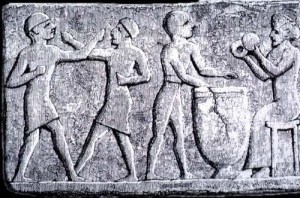
Terracotta relief depicting two men boxing to musical
accompaniment, c. 1200 B.C.E., Sinkara (modern-day Tell as Senkereh, Iraq).
Source: Flickr at http://www.flickr.com/photos/pankration (Pankration Research
Institute’s photostream).
The common people also participated in a variety of sports and games during holidays. Stone carvings, metal art and terra-cotta (red clay) plaques show that boxing and wrestling were especially popular in Mesopotamia. Two men would dramatically beat on an enormous drum during boxing matches, probably to add excitement to the event.[2] The Mesopotamians also played polo, except that instead of riding on horses, the players sat on the shoulders of other men.[3] Interestingly, there is evidence that the Mesoamericans—located an ocean away in Central America–were playing polo this same way.
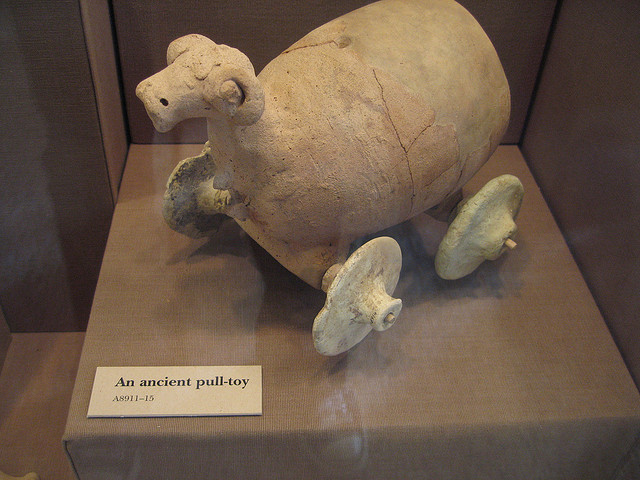
An ancient pull-toy at the Oriental Institute Museum.
The children of Mesopotamia were encouraged to play with miniature toys not only for fun, but also to help master adult skills. They played house with dolls and tiny animals and furniture. They had toy chariots, wagons and ships. They were given safe weapons so that they could imitate the adults in hunting and battle. These included bows, arrows, sling shots, long sticks for throwing and even boomerangs. They also had action games and toys like spinning tops, rattles, jump ropes, balls and a game almost like hockey, except that players used mallets and a puck.[4]
Many of today’s toys are similar, but now both children and adults can enjoy very realistic play anytime. We don’t have to wait for a holiday or festival like the Mesopotamians did to play sports or relax. With the invention of video gaming systems like Wii, we can play after school or in the evening with our families. Systems like Wii let us go through all the motions of hunting or boxing without the risk of being hurt. The technology allows us to control the actions of our character on the TV screen by moving our hands and feet with remote gadgets. We can gain skills at sports and martial arts without ever leaving our homes. This is as close to the real thing as pretending could ever be.
Throughout history, people have played games, not only for recreation, but also to learn activities important for life in their society. Today, Wii turns play into an active imitation of life for children and adults alike. Just as the Mesopotamians did in their day with their leisure activities, we in the 21st century also take our fun seriously.
Activities
Mesopotamia Art Project: Compare a Mesopotamian father in battle and his children playing war with their toys.
- Click here for pictures of Ancient Mesopotamian weapons.
- Measure and mark a point halfway down a piece of art paper and draw a horizontal line across to the other side. You are going to make two pictures about a Mesopotamian family. Go to the above link for pictures of ancient Mesopotamian weapons. Use the pictures to help you draw accurate pictures of the weapons.
- In the top space, draw a Mesopotamian warrior in battle using his weapon (sword or spear). In the bottom space, draw his two children at home playing with their toy weapons (wooden swords, throwing sticks or other toy weapons mentioned in the blog). You can add other miniature toys from the story like toy chariots, wagons and ships to the picture.
- Label your picture with the words, “A Mesopotamian Father at War” and “Mesopotamian Children Playing Warrior.”
Qing Dynasty Building Blocks: Just like todays’ teachers, educators in the Qing Dynasty knew that building blocks were great toys to help expand growing minds, foster intelligence and have creative fun. You can make your very own building blocks with tools around the house, but make sure you ask your parents to help!
- Collect empty boxes. You’ll probably find most of the boxes in the kitchen. Cereal and food boxes are perfect.
- Wrap the boxes in plain wrapping paper or construction paper. Reinforce the corners with clear tape. You might want to let your parents do this step.
- Use colored markers, pens and pencils to decorate the boxes. You can draw windows and doors and make your own houses and buildings, or draw multiple houses and buildings on each box and create neighborhoods. Leave the boxes plain and use them to build anything you can imagine! Be really creative and go 3D: cut out windows and doors, paste on pictures of greenery from magazines, draw and cut out figures of people, etc.
- Write a page as if from your own diary and describe a day living in your neighborhood. Who are you? What period of time do you live in (e.g., ancient China, modern day city)? Who are your friends? What do you like to do together? What do you see when you walk around your neighborhood?
References
1. Bancroft, Norman, Living in Ancient Mesopotamia, (Infobase Publishing, 2008), 176.
2. Murray, Steven Ross, “Boxing Gloves of the Ancient World”, Journal of Combative Sport, July 2010, http://ejmas.com/jcs/2010jcs/jcsart_murray_1007.html
3. Nejat, Karen Rhea Nemet, Daily life in ancient Mesopotamia (Greenwood Publishing Group, 1998), 165.
Posted in Blog, Kids Blog, Kids: Public Life, Kids: Recreation, Kids: Science and Tech, Kids: Sports, Public Life, Recreation, Science and Technology, Sports
Tagged ancient history, AntiquityNOW, games, Mesopotamia, military, toys, war, Wii
Celebrating Buddha’s Birthday: 1,800 Years of Buddhist Art Preserved by 21st Century Virtual Reality

The digital reconstruction of the south cave of Xiangtangshan with the missing fragments shown in yellow and reproduced in their original location. Image courtesy of BBC News.
Many people around the world are celebrating the birth of Gautama Buddha today. Across the globe revelers are gathering to honor the sage and his teachings that are the foundation of Buddhism. However, not everyone celebrates the milestone on this day. In fact, there are several different recognized days that differ according to the country and even the particular branch of Buddhism. Regardless of the day chosen, it is a time of joy, reflection and community. Continue reading
Posted in Art, Blog, Computer Technology, Culture, Public Life, Religion, Science and Technology
Tagged AntiquityNOW, Buddha's birthday, Buddhism, preservation
KIDS’ BLOG! Today’s Art Inspired by the Ancient Maya and Aztec Civilizations

Monster Mash by Dan Fenelon
Dan Fenelon, AntiquityNOW’s Virtual Artist in Residence, looks to the past to feed his boundless imagination. He reaches in to antiquity and plucks inspiration from many ancient cultures to create a new art that is both modern and timeless. Two of the civilizations that inspire him are the Mayas and the Aztecs. Both flourished for thousands of years and created some of the most beautiful and recognizable works of art and architecture. Continue reading
Posted in Art, Blog, Culture, Kids Blog, Kids: Art, Kids: Culture
Tagged ancient art, AntiquityNOW, AntiquityNOW month, art history, Aztec, Dan Fenelon, Maya, Mesoamerican
Ancient Green Technology
 Today, we celebrate the earth and we think about all the ways we can help to cherish and protect it. We have come so far in our efforts to develop new ways of preserving our planet and with modern technology our carbon footprints are getting smaller every day, but the concepts that allow us to “go green” actually date back tens of thousands of years.
 You can learn all about “seven incredibly innovative uses of geothermal, water, wind and solar power from around the ancient world” in the fascinating article 7 Ancient Wonders of Green Design & Technology from WebEcoist.
As you celebrate today’s earth, remember the ancients who cared for and protected their planet and provided us with the blueprints to do the same.
Posted in Biology, Blog, Culture, Engineering, Science and Technology
Tagged ancient history, AntiquityNOW, Earth Day, green, preservation, technology
Welcome to Dan Fenelon, AntiquityNOW’s Artist-in-Residence
 Dan Fenelon’s art blends an infusion of pop, cartooning, modernism and tribalism along with an explosion of vibrant colors.
Influenced by cartoons from the time he was a child, his art has a whimsy and fantasy that can be embraced by children and adults alike. The viewer becomes lost in a phantasmagorical world of dancing figures and prancing animals, floating skulls and geometric faces, curvilinear lines and mosaic-like backgrounds, ancient symbols resonating with a post-modern sensibility. It’s a tangled web of delight and astonishment that lures you deep within this art form, and you emerge breathless from the netherworld of Dan’s imagination.
Look for upcoming announcements regarding our partnership with Dan. And take a look at the video below to see Dan’s unique view of ancient imaginings.
Posted in Art, Blog, Culture, Fashion
Tagged ancient history, antiquity, AntiquityNOW, art history, Aztec, Dan Fenelon, inca, Maya, modern art
Cracking the History of Easter Eggs

Decorated Easter eggs
This Sunday, millions of children will be on the hunt for Easter eggs. While Easter eggs are associated with Christianity, the egg as a symbol of spring is found in cultures around the world and has been associated with renewed life for thousands of years. Continue reading
Posted in Blog, Public Life, Religion
Tagged ancient history, AntiquityNOW, Easter, spring
It’s the Power of Love: St. Valentine and the Romantic Brain
 It’s Valentine’s Day. Moonlight and roses, chocolate and Hallmark cards… ahhh, the power of love. But why do we love? What is that irresistible draw to the heart and soul of another human being?
For such a popular holiday, Valentine’s Day is marked by an interesting historical fact—we’re not really sure of its true origins. The actual St. Valentine is a martyred figure associated with three stories from the early Christian Church. In one, St. Valentine was a Christian priest thrown into a Roman prison for preaching his beliefs. On February 14, he was beheaded not only for disputing Roman deities but also for allegedly curing the jailer’s daughter of blindness—a miracle not looked kindly upon by the Romans trying to suppress the upstart religion. His farewell letter to the jailer’s daughter, signed “From your Valentine,” and the letters he received and sent from jail to the friends who cared for him supposedly began the exchange of notes of affection for this holiday. Continue reading
Posted in Biology, Blog, Holidays, Public Life, Science and Technology
Tagged ancient history, AntiquityNOW, brain, Claudius, history, Roman, St. Valentine, valentine's day




 AntiquityNOW