
 It’s AntiquityNOW Month! Create a beautiful mural with artist Dan Fenelon’s paint by number design for AntiquityNOW inspired by the Minoan “Fresco of the Dolphins” on the island of Knossos near the north coast of Crete.
AntiquityNOW Month: Make Something Monday! Paint by Number Minoan Fresco
AntiquityNOW Month: Factoid Friday! Orson Wells at 100
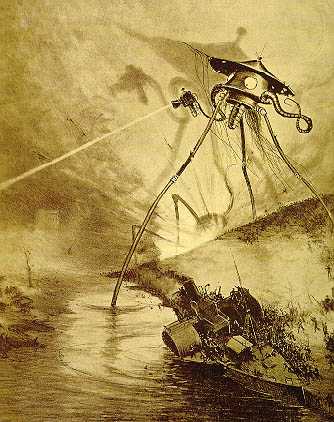
“War-of-the-worlds-tripod” by Henrique Alvim Correa,1906
May 6 marked the 100th anniversary of the birth of legendary American filmmaker Orson Wells. Hear his infamous radio recasting of War of the Worlds and listen to his conversation with the book’s author H.G. Wells as they share their surprise at the public’s hysteria at this fictional account of a Martian invasion. (For a real treat, watch a countdown of Wells’ best films here.) As well, discover how flying machines have been a motif in numerous cultures for millennia. Click here.
Posted in Blog
Tagged AntiquityNOW, AntiquityNOW month, history of flying machines, Orson Wells, War of the Worlds
Our Most Popular Post of All Time: The Invention of the Wheel
 During AntiquityNOW Month in May, we celebrate past lives and how their contributions continue to influence us today. Originally published on August 20, 2013, The Invention of the Wheel: How Ancient Sumerians Got Humanity Rollin’ relates the fascinating history behind the invention of the wheel. What better way to acknowledge the ingenuity of our ancestors than by lauding those who got humanity rolling? And now, we’ve added a new activity at the end of the article that helps you explore more about the world’s oldest wheel, which is crafted from ash and oak, dated to 3,200 BCE and discovered in modern-day Slovenia. Click here to read the original article or scroll down to get right to the activities! Let’s get rollin’! Continue reading
Posted in Blog
Tagged ancient history, AntiquityNOW, history of the wheel, invention of the wheel, Ljubljana Marshes, Sumerian wheel
Bon Appetit Wednesday! Ancient Celtic Woodruff Spiced Wine
 May Day was last Friday, but it’s not too late to celebrate the fresh and breezy month of May and the ushering in of a warm and beautiful spring! The Celts loved the change in seasons and they celebrated with the Beltane festival. There was plenty of food and drink, of course. But like other ancient cultures, the seasonal festival reflected the Celts’ deep spiritual intertwining with the natural world around them. Continue reading
Part 1, Tricks of the Trade: From Ancient Symbols to a $70 Billion Brand (That’s You, Coca-Cola!)
 The human mind is complex, elegantly fashioned and constantly surprising us as to its capacity. A recent study by a team of MIT neuroscientists has found that the brain can process images that are seen by the human eye for as little as 13 milliseconds, evidence of the extraordinary processing speed of the mind. Mary Potter, an MIT professor of brain and cognitive sciences and senior author of the study, observes: “The fact that you can do that at these high speeds indicates to us that what vision does is find concepts. That’s what the brain is doing all day long — trying to understand what we’re looking at.”[1] Continue reading
Posted in Art, Blog, Communications, Culture, Public Life
Tagged ancient history, ancient marketing, ancient symbols, AntiquityNOW, cornucopia, ichthus, ichthys, okay sign, swastika
AntiquityNOW Month: Make Something Monday! Ancient Pictographs and Hand Stencil Activity
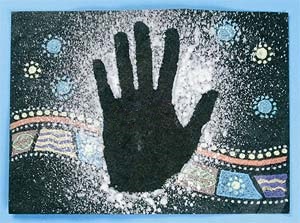 It’s AntiquityNOW Month! Pictograms and pictographs have been telling stories for thousands of years. Read more here. Click here to visit a website with instructions on how to create your very own hand stencil.
Factoid Friday! Ancient Ice Cream
 The origins of ice cream most likely began with ice that was flavored with fruit and essences by the ancient Chinese around 3000 BCE.

Learn more about ice cream and the 5,000 year old delectable history of the hot fudge sundae.
Posted in Blog
Tagged Ancient China, ancient desserts, ancient history, ancient ice cream, AntiquityNOW
The Nepal Earthquake: Cultural Heritage and the Soul of a People

How do societies define themselves? To some degree or another, they look to the past. Where their people originated, the gods who have guided and protected them, their cultural accomplishments through the ages and the ancient sites that embody their historical heart.

Dharahara Tower before and after the earthquake. Image credit: NPR, Sunil Sharma/Xinhua/Landov and Narendra Shrestha/EPA/Landov
The massive earthquake in Nepal has resulted in thousands of deaths and casualties. Pictures reveal vast swathes of devastation, and as with most catastrophes, it’s hard to distinguish amidst the rubble the evidence of previous human habitation. The earthquake now is embedded as a fault line of the nation’s 21st century self: the time before the earthquake, the time after. Once again, this ancient land has raised itself upward and wrenched itself away from earth’s pull. Eventually, after the geological frenzy, it will settle back down again. In Nepal’s strata, in its layers of broken tiles and artifacts, history reveals itself as relentlessly repeating. Continue reading
Bon Appetit Wednesday! Mung Bean Quinoa Soup
 The mung bean. The name doesn’t inspire thoughts of deliciousness, the tongue doesn’t begin to water with anticipation of scrumptiousness, but maybe it should. Perhaps the rest of the world needs to get on board with a fact that India and China have known for centuries: Mung beans are fabulous. Today we’re bringing you a recipe for Mung Bean and Quinoa Soup (learn about the ancient grain quinoa in our post here). It is packed with healthy goodness and is a perfect comfort food. Continue reading
AntiquityNOW Month is Almost Here!
 This Friday is the start of the second annual AntiquityNOW Month when we celebrate all things ancient, with a modern twist! There are plenty of ways for you to join in as we look to the past for some of today’s most innovative concepts. We’ve created a list of ideas and inspirations on our AN Month web page to celebrate ingenuity through the ages. Here are a couple of fun highlights you can look forward to: Continue reading




 AntiquityNOW